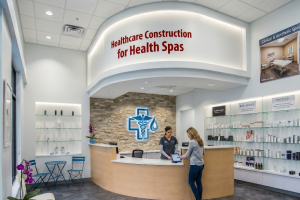
Healthcare Construction for Health Spas: The Smart Guide to Building for Business Growth…
Healthcare construction for medical spas is experiencing unprecedented demand as the global medical esthetics market is projected to grow at a compound annual growth rate of 13.0% from 2024 to 2032. Increased customer awareness, technological advancements, and a growing emphasis on preventative care and wellness drive this growth. Building a health spa facility requires strategic planning that balances clinical functionality with exceptional guest experience. In this piece, we’ll walk you through everything in healthcare construction projects for health spas. We’ll cover market considerations, how to select healthcare construction companies, best practices for healthcare design and construction, effective healthcare construction management strategies, and how to use healthcare construction services to create a facility that supports your business growth.
Understanding the Health Spa Healthcare Construction Market
The Change Toward Preventative Care and Wellness Services
Preventive care is altering the healthcare map. Getting preventive services reduces the risk for diseases, disabilities and death. Yet millions don’t access recommended preventive health care. The numbers tell a compelling story. Nearly 80% of chronic medical conditions could be prevented by healthy lifestyle behaviors. About 63% of deaths from chronic diseases stem from unhealthy lifestyle choices.
Health spas can address this gap. Preventive care covers annual wellness visits and health screenings for blood pressure and cholesterol. It also includes mental health assessments and lifestyle counseling on diet, exercise and stress management. Over half of all adult Americans live with at least one chronic disease. This makes prevention both a health necessity and a business chance.
The financial case strengthens this change. Investing only $10 per person annually in community-based programs centered around physical activity and nutrition could save over $16 billion yearly. Customized preventive medicine programs that deliver individualized care focused on lifestyle behavior modification show reduced emergency room visits. Healthcare expenditure savings increase over time.
What Makes Health Spa Construction Different from Traditional Healthcare
Medical spas occupy a distinct position in healthcare construction projects. They require the cleanliness and functionality of a healthcare facility combined with the comfort and atmosphere of a wellness retreat. This dual nature sets them apart from traditional medical buildings.
State-of-the-art treatment rooms must coexist with peaceful relaxation zones. High-quality finishes, sound control and lighting affect client experience while meeting specific health and safety codes. These include ventilation standards, ADA accessibility and infection control measures. Color palettes, materials and signage reinforce brand identity while enhancing comfort and privacy.
Identifying Your Target Market and Construction Needs
Understanding your target market drives construction decisions. Medical spa facilities serve local residents and vacationers. Each group has different expectations and service needs. Constructing innovative, green and health-focused facilities allows you to design spaces that meet exact tenant needs. This ranges from floorplan layout to specific amenities and technology features.
This tailored approach boosts functionality, space efficiency and tenant satisfaction. Well-placed properties attract high-quality tenants for property owners and developers. They generate reliable investment returns while varying portfolios.
Key Considerations Before Breaking Ground
Choosing Between New Construction and Renovation
The first step gathers assumptions rather than setting goals right away. This approach reveals stakeholder priorities and allows for creative problem-solving. Age plays a role in these decisions. Healthcare facilities now renovate spaces as young as 10 years old.
Existing conditions present the biggest problem in renovation projects. Concerns are bringing buildings up to code and matching finishes. Modernizing spaces can eliminate return on investment. Mechanical, electrical and plumbing systems in healthcare facilities account for 35 to 50 percent of total construction costs. This is roughly double that of conventional commercial buildings.
New construction offers full design control and easier code compliance. Renovation provides faster occupancy, though contaminants like asbestos can add substantial time.
Infrastructure Requirements for Medical and Wellness Services
Healthcare facilities require specialized infrastructure beyond standard commercial buildings. This has advanced MEP systems and specialized medical gas systems. Backup power supply and advanced communication networks are also needed. These systems must support sophisticated medical equipment and maintain precise environmental conditions. They provide redundancy for continuous operation.
Working with Healthcare Construction Companies: What to Look For
Select companies with proven healthcare project experience and diverse medical facility portfolios. Companies offering self-performing services bring in-house teams of architects and engineers. Project managers and construction workers allow better coordination and quality control.
A complete guidelines and procedures manual demonstrates expertise. This manual should outline infection control measures and interim life safety measures that minimize risks during construction.
Permitting and Regulatory Requirements for Health Spas
Getting a general business license from local government forms the base. You’ll also need an Employer Identification Number for tax purposes and sales tax licenses for product sales. Health and safety permits and fire department permits are required.
Medical spa requirements vary by state. Some states require licensed physicians as majority shareholders. Others permit general business ownership as long as licensed professionals perform medical procedures. Facility-specific permits are business licenses and health department permits. Zoning permits, building permits and environmental permits for medical waste disposal are also needed.
Building a Patient-Centered Health Spa Facility
Designing the Client Journey from Entry to Exit
Patient flow shapes every aspect of healthcare design and construction. Strategic circulation helps people move naturally without hesitation, while clear zoning gives each area a distinct purpose: greeting, waiting, consultation, treatment, recovery. Privacy pathways guide clients away from public sightlines during personal moments of care.
Flow means completing an action with the least friction and discomfort. Thoughtful space arrangement identifies adjacencies that enable available movement at minimal distance and time. To name just one example, recovery rooms need proximity to nurses for monitoring and supply closets for restocking. Healthcare construction management teams must ensure incoming clients never mix with outgoing clients.
Treatment and Consultation Room Layout
Treatment rooms range from 90 to 120 square feet. They increase to 120 to 140 square feet when incorporating laser equipment. Consultation rooms require 100 to 120 square feet to accommodate examination couches, privacy screens, patient chairs, and hand hygiene facilities. Ceiling heights of 9 feet create spacious environments. Acoustic isolation prevents treatment sounds from adjacent spaces.
Integrating Fitness, Nutrition, and Mental Health Services
Wellness centers employ physicians, nurses, nutritionists, and mental health counselors who work together and address physical, mental, and emotional health needs. Services include annual exams, preventive screenings, chronic disease management, nutrition counseling, and mental health support among fitness programs.
Staff Areas and Operational Efficiency
Healthcare construction projects should allocate 70% for revenue-generating spaces and limit support spaces to 30%. Staff training, skill-based task assignments, and workflow optimization eliminate bottlenecks. Back-of-house design receives the same attention as front-of-house. This creates environments where practitioners feel excited and inspired.
Technology Integration for Modern Healthcare Delivery
Telehealth reduces infectious transmission risk and workload on medical staff. EHR integration allows individual-specific exercise programs tailored to medical history and limitations. Healthcare construction services now include digital communication apps, project management software, and automated booking systems.
Executing Your Construction Project Successfully
Selecting the Right Healthcare Construction Management Team
Healthcare-specific experience distinguishes successful projects from problematic ones. Partners should demonstrate proven track records in healthcare construction projects, with portfolios showing similar facilities. Technical expertise matters beyond general construction knowledge. Professionals need specialized skills in medical planning, MEP systems, medical gas installations and clean room standards.
Regulatory compliance expertise proves essential. Design and construction teams must understand Joint Commission requirements, NFPA codes and ADA standards to avoid pricey delays and modifications. More, strong interdisciplinary collaboration among architects, engineers, contractors and healthcare providers will give high-quality delivery on time and on budget.
Construction Phase Management and Quality Control
Quality Assurance prevents defects by establishing standards before construction begins. Quality Control inspects completed work to verify compliance. Regular inspections catch problems early when fixes cost hundreds of dollars rather than tens of thousands after opening.
Research shows rework costs between 7.25% and 10.89% of total project cost and potentially delays completion by nearly 10%. Poor quality could mean $3.6 to $5.4 million in additional costs and several months of delays on a $50 million project.
Managing Costs Without Compromising Quality
Build realistic budgets from the start that account for healthcare-specific requirements rather than applying standard construction cost models. Digital platforms centralize cost data, provide live financial health visibility and make change order processes efficient. Connected construction management software reduces siloed workflows that increase error risk.
Preparing for Opening Day and Beyond
Proactive compliance recognizes that unannounced accreditation surveys can occur shortly after occupancy. Project record documentation, test and inspection reports, permits, licenses, certifications and all required testing documentation should be ready and easy to retrieve. Designate an activation project champion supported by multidisciplinary teams with clear roles and responsibilities.
Building a successful health spa facility requires balancing medical precision with exceptional guest experience. Choose the right healthcare construction companies and follow proper planning protocols to position your business to capitalize on the growing wellness market. The investment you make today in quality design and patient-centered layouts will determine your competitive advantage tomorrow. Start with a full picture of the market, select experienced partners and never compromise on quality for short-term cost savings.
FAQs
Q1. Are medical spas profitable businesses? Yes, medical spas typically achieve strong profitability with average net profit margins of 15-25% once established. This is higher than most healthcare-adjacent businesses. For example, a medical spa generating $1.5 million in annual revenue with a 20% net margin would produce $300,000 in owner profit. Key factors affecting profitability include provider utilization rates, service mix optimization, and effective product cost management.
Q2. What is the projected growth rate for the medical spa industry? The medical spa market is experiencing significant growth, with the industry valued at $18 billion in 2023 and projected to grow at a compound annual growth rate (CAGR) of 18.7% through 2032. This expansion is driven by increased consumer awareness, technological advancements, and a growing emphasis on preventative care and wellness services.
Q3. What makes health spa construction different from traditional healthcare facilities? Health spa construction requires a unique blend of clinical functionality and hospitality esthetics. Unlike traditional medical buildings, health spas must combine the cleanliness and safety standards of healthcare facilities with the comfort and atmosphere of wellness retreats. This includes state-of-the-art treatment rooms alongside peaceful relaxation zones, high-quality finishes, specialized sound control, and lighting that enhances client experience while meeting health and safety codes.
Q4. What are the main infrastructure requirements for a medical spa facility? Medical spas require specialized infrastructure including advanced mechanical, electrical, and plumbing (MEP) systems, specialized medical gas and vacuum systems, backup power supply, and advanced communication networks. These systems must support sophisticated medical equipment, maintain precise environmental conditions, and provide redundancy for continuous operation. MEP systems alone can account for 35-50% of total construction costs.
Q5. What permits and licenses are needed to operate a health spa? Operating a health spa requires multiple permits and licenses including a general business license, Employer Identification Number (EIN), sales tax licenses, health and safety permits, and fire department permits. Medical spas also need facility-specific permits such as health department permits, zoning permits, building permits, and environmental permits for medical waste disposal. Requirements vary by state, with some requiring licensed physicians as majority shareholders.
Our Healthcare Related Design Build Services Combine the Function of an Architect, Engineer, and Construction Manager
CSP’s design build services are integrated and focused on the specific needs of your project. Design build projects allow for operational advantages and simplified contracts, that allow your project to be fast-tracked. > Learn More
Contact Us (859-538-6198) For a Free Consultation!
—
About CSP
Complete Structural Partners (CSP) provides commercial and residential contracting, renovation, and remodeling services to the Greater Cincinnati/Northern Kentucky area. We specialize in retail, office, healthcare, warehouse, and manufacturing construction projects. CSP provides quality craftsmanship that is completed on time and under budget. Our Interior Design Division provides decorating, staging, and space planning services as well as construction services for small remodeling projects.